

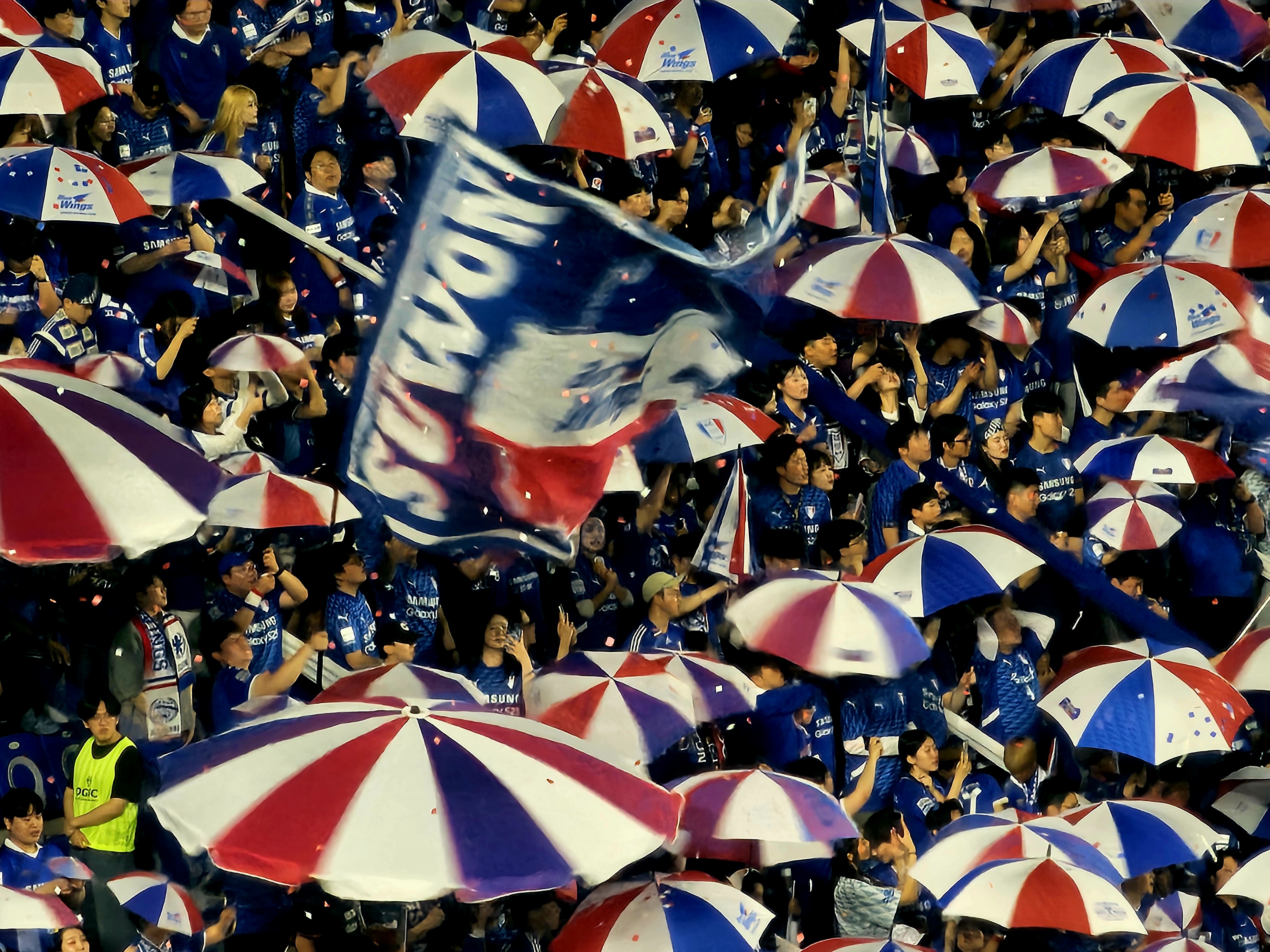
Suwon Samsung Bluewings drew a crowd of 21,153 for their second division derby with Suwon FC. This isn’t even their biggest crowd of the season. How does this compare globally to second tier clubs, and what’s the reason for their impressive figures?
As the players paused for a hydration break on 70 minutes for August’s Suwon derby, the attendance was displayed on the big screen. 21,153. This represents Suwon’s second highest league gate of 2026.
36,000 watched the legends match against OGFC (Manchester United) in April, but we’ll discount that fixture because it was an event more than a match.
It is important to provide some context. This was a derby match, and the clubs started the day in first and third in the table. Suwon Samsung are one of Korea’s traditional powerhouses, with the trophy cabinet to prove it.
However, this is their third straight season in the wilderness of Korean football. They’re not visiting Pohang, Ulsan, or Jeonju. Fans make early season plans for trips to Paju, Ansan, and Gimhae.
Despite this, every season, Suwon shatter the attendance record for K League 2, and their season average attendance increases. Success has not followed – in fact, Suwon experience humiliation each year.

In 2024, their first season at this level, Suwon averaged 10,362. They broke the attendance record when 15,308 saw them host Chungnam Asan. The following season, that average climbed to 12,048, helped by a new record crowd of 22,625.
This year, that average has jumped again, to 16,512. Daegu FC are next on 9,706. No other club has an average gate above 5,000. The K League 2 record was broken for the third time when 24,071 watched Suwon defeat Seoul E-Land.
Unlike some of the examples highlighted below, Suwon are not relying on major – but fallen – clubs to help fill seats. Old rivals like Seongnam FC and Busan IPark are in their division, but support for those clubs has waned massively.
Replacing Jeonbuk Hyundai and FC Seoul at Big Bird are Chungnam Asan, Gimpo FC, and Gimhae FC. Not to disparage the achievements of those clubs, but in comparison to the titans of K League 1, they are merely a footnote in history.
Before we look at the why, let’s compare the derby crowd and their season average to other parts of the world.
It is worth emphasizing immediately that what Suwon Samsung are experiencing is neither unique or unprecedented. They are not the best supported second division club in the world. Their figures, however, are highly unusual.
Europe (Excluding England & Germany)
England and Germany are football behemoths. Clubs several divisions below their top flights are capable of attracting the sorts of numbers that are usually reserved for first division clubs elsewhere. Otherwise, Europe is the natural starting place for these comparisons.
Spain’s Segunda División boasted an average league-wide stadium gate of approximately 12,680 spectators last season. However, several clubs, like Deportivo la Coruna, averaged 21,571, much higher than Suwon.
In Serie B the season average was 9,450, although Sampdoria averaged 24,068. Ligue 2, France’s second tier, doesn’t really compare to European rivals. AS Saint-Etienne did average a whopping 31,305, but across the league, the figure was 7,040.
From Portugal (1,898 per game) to Turkey (2,511), there are only a handful of clubs capable of welcoming 21,000 at a match, or averaging over 16,000.
The Americas
Brazil’s Série B is similar to Europe in that big crowds do happen, but strictly for legendary clubs experiencing historic demotions. When those specific giants aren’t in Série B, a 21,000 crowd is extremely rare; typical mid-table Série B matches draw under 7,000 fans.

The baseline average in Argentina (Primera Nacional) is well under 10,000. The USL Championship in North America averages between 5,000 to 6,000.
Asia
Outside of Suwon Samsung Bluewings, a second-division gate of this size is practically a myth across the rest of the continent.
Only a tiny handful of clubs in J. League 2, with massive infrastructure – such Yokohama FC – can occasionally flirt with a 20,000 crowd during a crucial derby or promotion decider. In 2025, the structural average was 8,888.
Finally, in Korea, Suwon Samsung are completely breaking the data curve for second-division football. The rest of K League 2 averages between 2,500 and 5,000 fans per game.
Suwon are exceptional, but not because no second-tier club anywhere can draw 20,000. They’re exceptional because they are sustaining that level despite repeated failure, while their league itself has dramatically lower attendance.
Legacy & Identity
Suwon Samsung were relegated in late 2023. Supporter outrage was intense as the players stood, heads bowed, in front of the North Stand for well over an hour after full time. If they were begging for forgiveness, they would be disappointed.
Pundits, players, and fans presumed their stay in K League 2 would be short. Let the bruised ego heal and enjoy a rare season out of the spotlight, visiting small cities previously never considered.
It didn’t work. A sixth-placed finish ensured Suwon didn’t even make the playoffs. In 2025, they improved to second, but were well-beaten in the playoffs by Jeju SK. And here we are, halfway through season three.
To understand just how rare Suwon’s feat is, we need to consider these factors.
Identity: Despite the shame of relegation, hardcore fans will not abandon their club. Supporters view relegation as an insult on the city, and the history of the club. Instead of walking away, fans will show up in defiance.
Kim Hay-ul believes Suwon boasts “the supporters who cheer the best among the other clubs. The fans love their team, support them more, and are more passionate, even when they lose.”
Generational fans: Suwon isn’t a big city by Korean standards, but it boasts two K League clubs and the current leaders of Korean Baseball, KT Wiz. Only Seoul, nine-times Suwon’s population, has more professional clubs in the two main sports.
According to Noah, Suwon is “home to the loudest and most loyal fan-base in this country. No other team could survive what we’ve gone through over the past few years. I will never give up. I got used to losing after the 11-game drought in 2023.”
Suwon FC were formed in 2003, but didn’t join the professional ranks until late 2012. KT Wiz were established the following season, although there was a now-defunct professional baseball team in Suwon at the turn of the century.
The Bluewings are only 30 years old, but they span generations. Older fans who followed the club in 1996 are now bringing their young grandchildren to Big Bird. KT Wiz and Suwon FC have not reached that level of support yet.
Match day atmosphere: It isn’t harsh to say the build-up to a regular Suwon home match, and the atmosphere inside the walls for those 90 minutes, far outstrips the quality of action on the field.
Englishman Josh Bamford creates YouTube content about the Bluewings. Suwon is “the best atmosphere you can get at a football match in Korea,” Josh states. “It’s not even close. It’s a toss-up between the Bluewings and Busan’s Lotte Giants (KBO) for the best sporting atmosphere in Korea.”
Disgruntled fans still enjoy the songs, the chants, the banners, and the second half umbrella display. Suwon are one of the very few clubs which doesn’t rely on an overbearing MC to excite spectators. The atmosphere is generated in the stands.
“There’s really nothing quite like it,” says Amelia Burke. “The atmosphere is always electric before and during the game. Once La Banda starts, everyone really gives their all and tries to support for the whole 90 minutes. And don’t get me started on the umbrellas.”

The reboot: Hiring Lee Jung-hyo as manager was a masterstroke, and that decision is responsible for the huge opening day crowd. Lee is an enigmatic young Korean manager who worked miracles with Gwangju FC. He could have taken a job abroad, but he chose to drop down a division and rescue Suwon.
Lee’s influence is limited to this season, and is a factor in the jump this year. However, the seeds of the growth were sown before his arrival.
A well-known Korean reporter, who contributed on the promise of anonymity, believes clubs in Japan were interested in Lee after his ACL Elite conquests with Gwangju.
“Lee has displayed good performances and results against strong Asian teams, including Johor Darul Ta’zim, Vissel Kobe, and Kawasaki Frontale in the ACLE.”
This is the manager Suwon wanted, and the figurehead the fans will rally behind.
Lee is only one part of this puzzling jigsaw. At the time of publication, Suwon are top of K League 2, but the gap is small, and there’s plenty of time left. If this season ends in heartbreak, like the previous two, will the fans finally start to walk away? It doesn’t seem likely.
Leave a Reply