

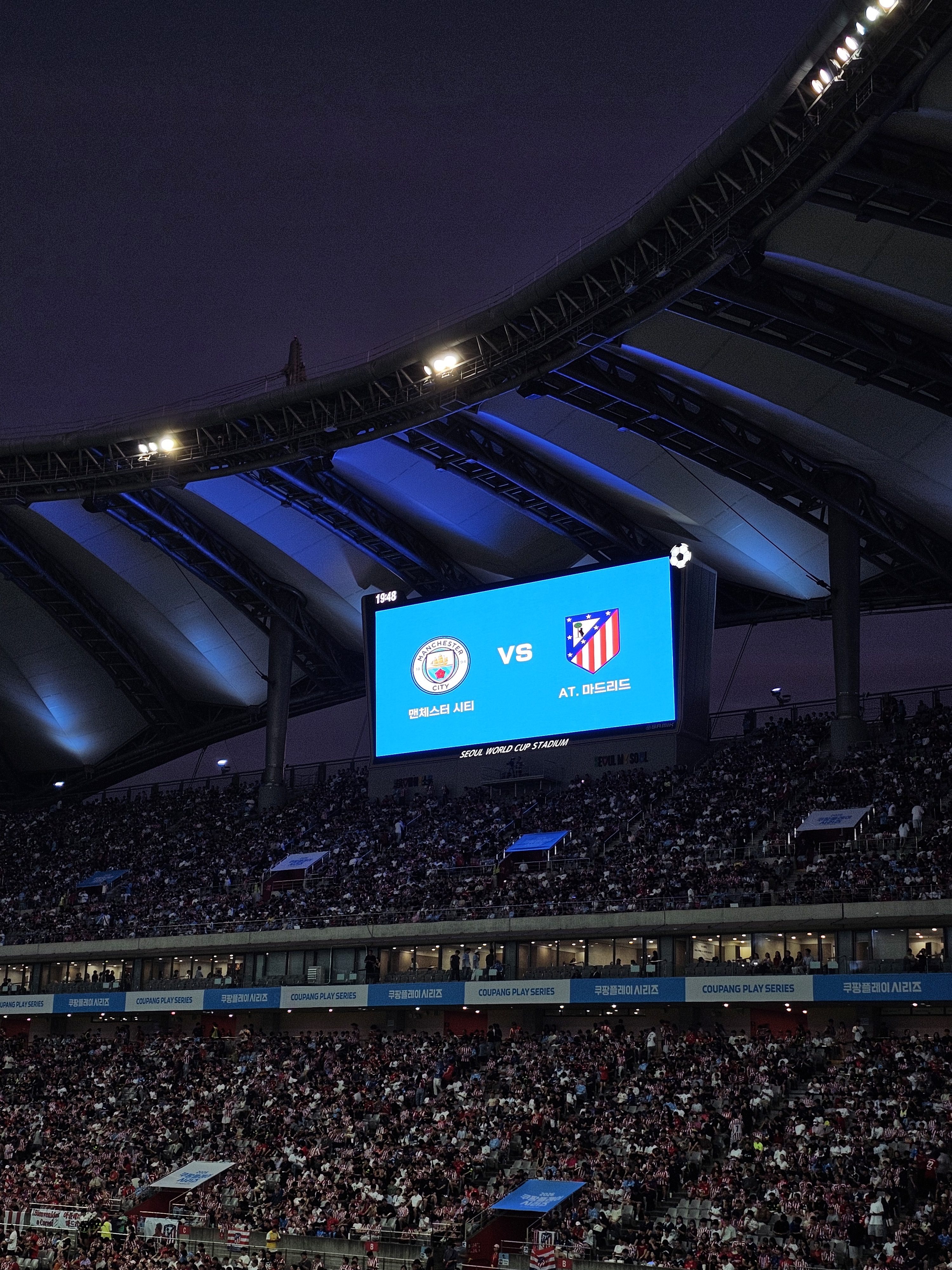
The two-match 2026 Coupang Play Series is over for another season. Overshadowed by extreme heat, one low turnout, and high-profile absentees, but saved by a local hero, was the Series a success, and should it continue?
Team K League, Manchester City, and Atlético Madrid were involved in this year’s edition. Atlético have been here before, and Team K League have been providing international teams good opposition for over a decade.
What worked well, what didn’t, and what would I change?
What worked well
One man’s introduction saved the 2026 Series. Lee Kang-in’s move to Atlético Madrid was the story of the Korean summer. Lee is incredibly popular with South Korean fans, and the prospect of his debut on home soil added several thousand sold tickets.

Lee was a substitute against Manchester City on Sunday. He spent most of the the first half on TV or waving to the fans behind him. His introduction midway through the second half was the highlight of the Series.
It didn’t matter the color of your jersey, everyone was howling for their guy as he removed his tracksuit. The time had arrived. He was standing by the touchline waiting to enter. The screams were thundering down the stands as the Spanish media next to me looked on in disbelief.
His first touch, a free kick, nearly went in. The organisers must have been praying for a goal. They had the moment they badly needed, and now they wanted more.
In total, 50,078 paid through the gates.
Despite the high-profile withdrawals, there were several huge names on show. City’s Phil Foden was undoubtedly the biggest international attraction. Antoine Semenyo, Rúben Dias, Omar Marmoush, Koke, and Jan Oblak were involved.
Even though crowds were down on previous seasons, there was nonetheless a strong sense of occasion outside the stadium before each match. And both clubs had pop-up stores in central Seoul which proved popular.
The branding was on point, with both Atlético and Manchester City wearing jerseys with player names in Hangeul. It is a small touch, but well-received.
Finally, the Team K League match against City on Wednesday had an All Star feel to it, similar to the KBO. Whilst it is weird to see fans singing songs of their biggest rivals, they appeared to enjoy that occasion.
What wasn’t a success
By far the biggest issue facing the Series in 2026 was not something the organizers could control. Korea has been gripped by a relentless and brutal heatwave for weeks. Seoul has seen temperature records tumble as tropical nights caused major inconvenience.
The midweek Manchester City vs. Team K League match was badly affected. There was no way to avoid the puddles of sweat developing on the media desk. It was hot, humid, and unpleasant.
The decision to skip the match was arguably made easier when the squads were announced. And this neatly leads us on to problem two.
Team K League was comprised of 24 players, two per K League 1 club. This made the matches enticing for fans of all 12 clubs, but it diminished the overall quality of the side. Instead of picking the best 24 players available on form – with a nod towards the marketing department – they went for equal representation.
Was this an All-Star team? A promotional team? A representative team? Or, a competitive team? It tried to be all four. The result was a side that represented the league, rather than one that necessarily represented the best of it. And this might explain why the home side was badly exposed by Manchester City in the first game.

Manchester City and Atlético Madrid, for their part, were short of several big name players, mostly due to the World Cup. Erling Haaland and Ballon d’Or winner Rodri headlined the absentees.
The list of missing players was released in advance, which can’t have helped. Just 28,036 attended the K League match. In a stadium with a capacity of nearly 70,000, that’s a lot of empty seats.
As a K League supporter, it is also jarring to see so many fans in jerseys of clubs based several thousand kilometers away when the domestic league is screaming out for bigger crowds. This isn’t a criticism of the people who paid to attend. But the biggest crowd of the K League weekend was 11,453.
Can the Series be fixed?
The series was a success. The traveling teams were treated to excellent training facilities and opposition. Local support was fervent. Korean fans felt like they were part of something big, between two heavyweight European clubs.
The biggest change I would make is dropping the Team K League element. The previous week, Jeju SK hosted Bayern Munich. In April, Suwon Samsung hosted a collection of Manchester United legends. Last summer, Barcelona faced FC Seoul and Daegu FC.
A rotating list of K League clubs would make these friendlies much more enticing, even if the European opposition are short several key players. Imagine, say;
FC Seoul vs. Arsenal
Suwon Samsung vs. AC Milan
Ulsan HD vs. PSG
Jeju SK vs. Barcelona

The matches would carry more meaning. A real home team against powerful opposition. The flags, the songs, the jerseys. That identity would create a better atmosphere.
There is an argument against such a schedule. Some of the K League clubs will never the opportunity to face these teams, no matter how fair we attempt to make it. Will neutral K League supports from Pohang watch Ulsan vs. PSG? Maybe. But unless their club also gets a crack, it just won’t feel the same.
The Coupang Play Series doesn’t need to be scrapped. It just a stronger K League identity. K League’s strength starts in the stands. Show the European teams what we have over here.
As Darron Gibson said after facing Suwon Samsung in May, “I’ve never experienced anything like that.” Let everyone experience real K League.
Leave a Reply