

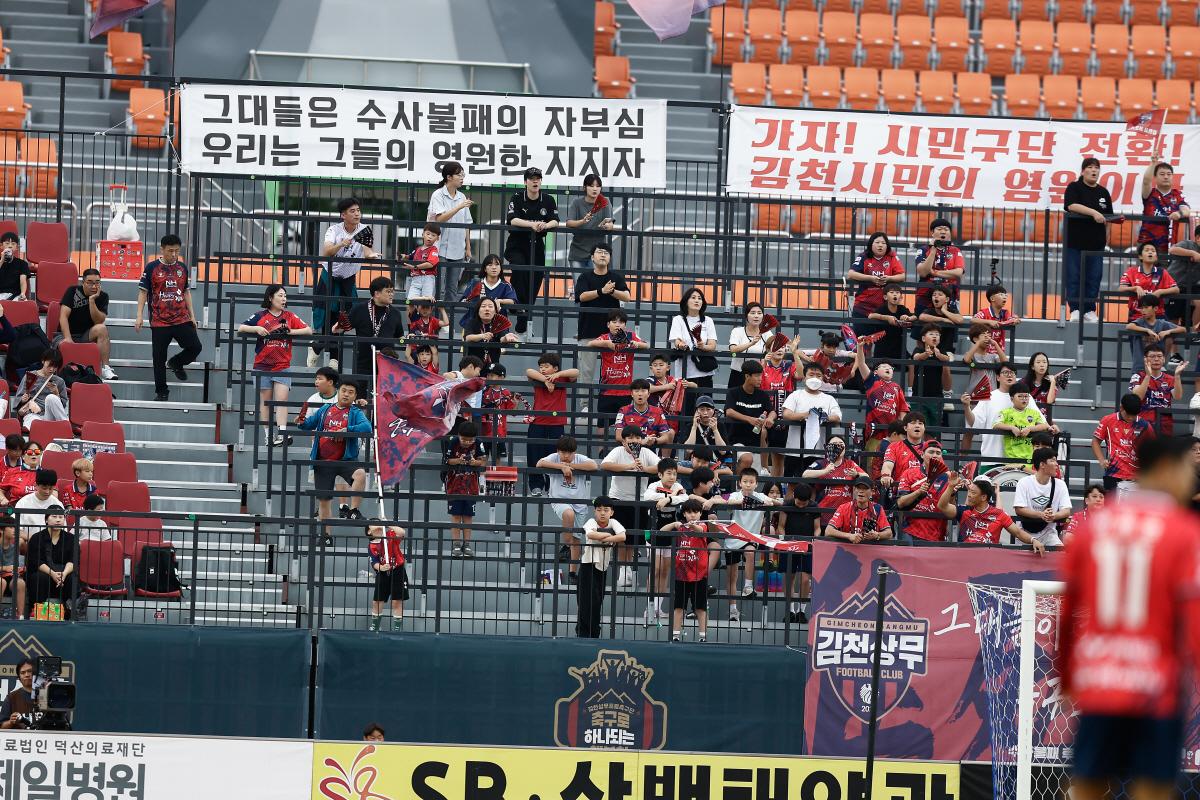
On a hot Saturday afternoon in October, Gimcheon Sangmu played out another home match in the shadow of the mountains. Beyond the open stands, the landscape was spectacular. Inside them, there was barely a crowd to match it.
Before the season started, we knew Sangmu were leaving Gimcheon. But October’s visit of Anyang came immediately after a decision was made not to establish a civic club. That decision impacted the match day attendence. From McDonald’s to misery, this is the story of Gimcheon Sangmu.
Gimcheon has only been a stop of the K League circut for six years. It boasts the quintessential city-owned concrete block stadium with fabulous floodlights, no roof, and a big capacity. From Paju to Changwon, Korean towns and cities have a stadium that looks just like Gimcheon’s.
There’s also a nearby KTX station and easy access to the country’s main north-south highway. For several reasons, Gimcheon ticks almost every box for a professional football club. Almost. Its population of 139,000 ranks it 62nd nationally.
And yet, by early December, it will no longer be a K League stop.

If you’re unaware, Sangmu is the sports division of the Republic of Korea Armed Forces. Every member of the squad is completing mandatory military service, which typically lasts around 18 months. Players aren’t bought or sold. There are no foreign stars. Eligible footballers apply to join, but all are accepted. Those who don’t must complete their service in the lower leagues.
Sangmu has no permanent home. They’ve been based in Seoul, Gwangju and Sangju before moving to Gimcheon. They are not permitted to stay forever. Host cities use Sangmu as a trial run before establishing a civic club when their lease expires. Gwangju did that. Sangju opted not to. Gimcheon has chosen the same path.
At the time of writing, Sangmu have no home for 2027. If they’re unable to find a host city by the new year, they will play away matches for the entirety of the next K League 2 season. There are rumours of interest from other cities, but none has signed a contract yet.
The players are discussing the uncertainty surrounding their future. “We players have been talking a lot among ourselves,” says Hong Yoon-sang. “We still don’t know what will happen next year. Nothing has been decided, so I think the players are feeling frustrated as well. For now, we’re just waiting.”
Hong’s parent club is Pohang Steelers. The midfielder wasn’t able to secure military exemption through international competition, such as winning gold at the Asian Games. Still, he is enjoying his experience.
“First of all, being part of Sangmu means that, ultimately, you’re serving in the military, so there are quite a lot of restrictions. But in some ways, I think you could say that you feel more at ease. There are also a lot of positive aspects to the experience. Another advantage is that there are lots of people around my age, which makes the experience more enjoyable.”

Globally, military-linked clubs exist in several countries, such as in Iran, Russia, and Rwanda. Some are dedicated army clubs like Sangmu, and others have historical links. The status of these clubs varies from country to country, depending on military requirements.
“I don’t think there is much difference in mindset.” Park Cheol-woo, on loan at Sangmu from Suwon FC, told me last year. “Co-ordination and training programs are different from my original team, but I don’t feel much difference in mentality.”
Kim Ju-chan recently returned to Suwon Samsung after a successful spell in Gimcheon. “When I was with my original team (Suwon Samsung), I was a little bit free from aspects in life,” Kim notes. “But in the military, the system and environment had changed. I exercised. The only thing I could do was exercise. So I felt my body getting better while exercising, and I learnt from the senior players and sergeants.”
Even players on opposing teams expressed their respect. Anyang’s Dutch defender Danny Bekker has “a lot of respect for Gimcheon Sangmu and for what they do during their military service. To also play in K League 1, I think that’s a difficult job to do while fulfilling their military duties.”
The players who joined Sangmu this autumn will also benefit from what Park described as “the military spirit imprinted in our minds” but they will have to do so away from Gimcheon. They knew this was coming. Sangmu signed a 4+1 year contract with Gimcheon, but that was extended by another year, to cover 2026.
Spending an entire season travelling isn’t ideal. They will have no opportunity to build a local following or play in front of fans who can cheer for them.

Even though Gimcheon is a small city, Sangmu players did have a small but vocal home fan base at their matches. “I’m really grateful,” Hong continues. “The Anyang match came after it had been confirmed that the team would be disappearing, but despite that, the fans still came to the stadium, supported us, and made their voices heard. I’m really thankful to them for that.”
Gimcheon Sangmu will be dissolved after their final match of the season. Operating a club in K League 2 requires an annual budget of at least $8 million. Despite some local support, the city will not meet those costs.
That local support came from an usual source. Since February last year, a “waving campaign” has been run by Gimcheon Sangmu staff on most weekday mornings at the busy McDonald’s intersection in the city.
Local fan Jaron explains:
“The idea is to cheer on Gimcheon citizens to brighten their day as they commute to work. Often, drivers roll down their windows (or honk their horns) to acknowledge our presence.”
The initiative proved successful, so in May 2025, they extended it to Tuesday nights for 45 minutes. This time, the aim was to lift the spirits of workers heading home. Fans, young and old, can wave alongside club officials in the evening.
Numbers were, sometime, low, but the fans kept coming. They weren’t just waving to brighten the days of the local residents. They also used it to campaign for a city-run professional club to be established. They knew Sangmu would leave. But they didn’t want the Armed Forces club to take professional football with them.
The waving campaign was ‘a type of community service,’ Jaron explains. The players understood what the campaign meant to the city. Unfortunately, the city chose not to act.

Before returning to Suwon, Kim Ju-chan said he was “thankful for Gimcheon—the club, the support of the citizens, and the people on the streets who support us.” The players felt it. It wasn’t enough.
Their final home match will be against Pohang Steelers on December 5. The walls will be stripped of the photos and signed jerseys. They’ll sell off the remaining merchandise, take down the bunting and advertising boards.
Over winter, the snow will fall and the air will be cold. Those stunning mountains will be painted white. Locals residents dreaming of spring’s first light will have to do so knowing it won’t come with professional football like before. Sangmu will be gone. And so will football.
Leave a Reply