

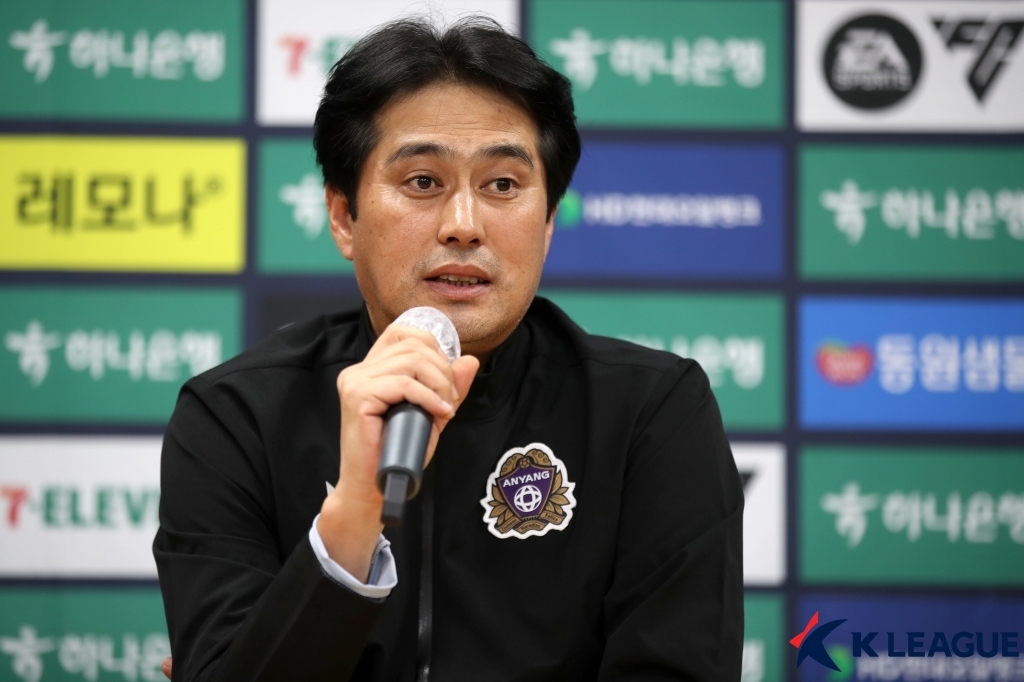
12 months to the day since Anyang’s finest hour, Yoo Byeong-hoon’s time as FC Anyang manager is uncertain tonight. The man with violet blood coursing through his veins built a legacy that has changed the club in Anyang forever.
FC Anyang closed out the 2023 season with a narrow home win over Cheonan City. It was November 26. It was dark, grey, and cold. I was there, not particularly enjoying the day. Anyang would finish sixth, below expectations and outside the playoffs.
12 months prior, Anyang brought Suwon Samsung to the 119th minute of a relegation/promotion playoff, only to fall just short. Manager Lee Woo-hyeong would have one more crack at promotion, but it didn’t work out.
November 26 marked the end of that Anyang era.
Anyang opened their 2024 season on March 1. It might have been sunny, but it was bitterly cold. 8,802 supporters took on the harsh conditions, and enjoyed a fine 2-0 win. Immediately there was a feeling that something was developing.
I did not know it at the time, of course, but I would return to Anyang Stadium nine months later to see Anyang lift the K League 2 trophy.

Seongnam FC were Anyang’s opponents. The Magpies were considered title challengers after a winter of strong investment. Suwon Samsung, reeling from a shock relegation, were another powerful force. There was little fuss about Anyang, under the control of rookie manager Yoo Byeong-hoon.
Yoo had spent most of his coaching career in Anyang, either side of stints at Asan Mugunghwa, Seoul E-Land, and Korea U-18. He was assistant to Lee during the 2022 season when Anyang missed out on promotion.
Looking back on his managerial debut, several names are still with Anyang today. Kim Da-sol, Lee Tae-hee, Kim Young-chan, Lee Chang-yong and Ju Hyeon-woo all started that day. Kim Jung-hyun, Kim Woon and Han Ka-ram were also involved, while Kim Dong-jin was already at the club.
There was another name in the team that day. An unknown play-maker from Brazil making his debut called Matheus Oliveira. Matheus might be Anyang’s greatest-ever player.
None of these players had extensive K League 1 experience. This was a squad of K League journeymen, mostly bouncing around the divisions, but Yoo turned them into champions.
It is very telling that those players are still hugely influential in Anyang today, despite the majority in the twilight of their careers. These are the limitations of a civic-run club.
Nonetheless, Anyang were up for the first time in their history. To say Anyang is a different club to 2022 would be the understatement of the century.
It wasn’t that long ago Anyang Stadium was an aging, multi-purpose area with a running track and average facilities.
Now there are three pitch side stands minimizing the influence of the track. Several blocks of seats are still available in the original structure. Over the World Cup, the club, with the city, built a huge picnic area and viewing platform.
There has been a massive increase in flags, with pockets of fan groups dotted across the stadium, creating one of the best match-day experiences in Korean football.
Not just that, but fans now wave purple light sticks, which comes across really well as nightfall approaches. They’ve somehow created a warm, friendly atmosphere in a stadium that looks increasingly in need of major reconstruction. Food trucks have exploded behind the goals.
A new club store has opened, replacing the shack next to the ticket office. The media centre has moved from a cramped hole in the wall to a fine, modern facility next to the store.
It all points to a club that’s become extremely confident and assured in its surroundings.
Yoo can’t – and won’t – take all the credit for this. Anyang are a model example of a city-run club. With several limitations and small resources, they’ve forged an identity at the highest level of Korean football.
But let’s be honest here – fans pay to watch the team winning. What was Yoo’s job? Picking the team and the style of play. Wins came, delivered with an underdog team playing high-tempo, fun football.

More fans means more sponsors and partners.
For their K League 1 debut, Anyang travelled to defending champions Ulsan HD and won. Ulsan were beaten again later that season. Daegu were hit for four. So were title-chasing Gimcheon. Daejeon, who finished second, also fell.
Then there was Seoul World Cup Stadium on August 31, 2025. A 2-1 win over FC Seoul — the club many Anyang fans despise because of its history in the city, and its controversial departure under the cover of darkness.
12 months to the day since that seismic victory, the mastermind behind it may walk away. Incredibly, this comes just over a week since Seoul romped to a 7-0 victory against his beloved Anyang.
It was only after news spread of Yoo’s apparent resignation, that I realized how many Anyang matches I’ve attended. Spanning eras in a very small period of time. I’ve watched Anyang go from just another K League 2 club struggling to attract 3,000 fans, through COVID-19, near-promotion, decline, and, finally, to unimaginable heights.
The job of any manager is to take a group of players and make them better. We’ve established Yoo did exactly that. But we can also compliment his extra role, in helping – with others – to create a new culture around the club.
Yoo delievered far more than a trophy, a promotion, or a collection of memorable victories. He showed Anyang supporters that this club could compete with the biggest teams in Korea. He brought respect to FC Anyang.

I’m sure Yoo Byeong-hoon will return one day, as a guest, a paid spectator, a pundit, or perhaps as an opposition manager. He’s entitled to stand on the pitch, look around, and say to himself;
‘Look at what we’ve done to this place.’
And that will be Yoo Byeong-hoon’s legacy.
Leave a Reply