

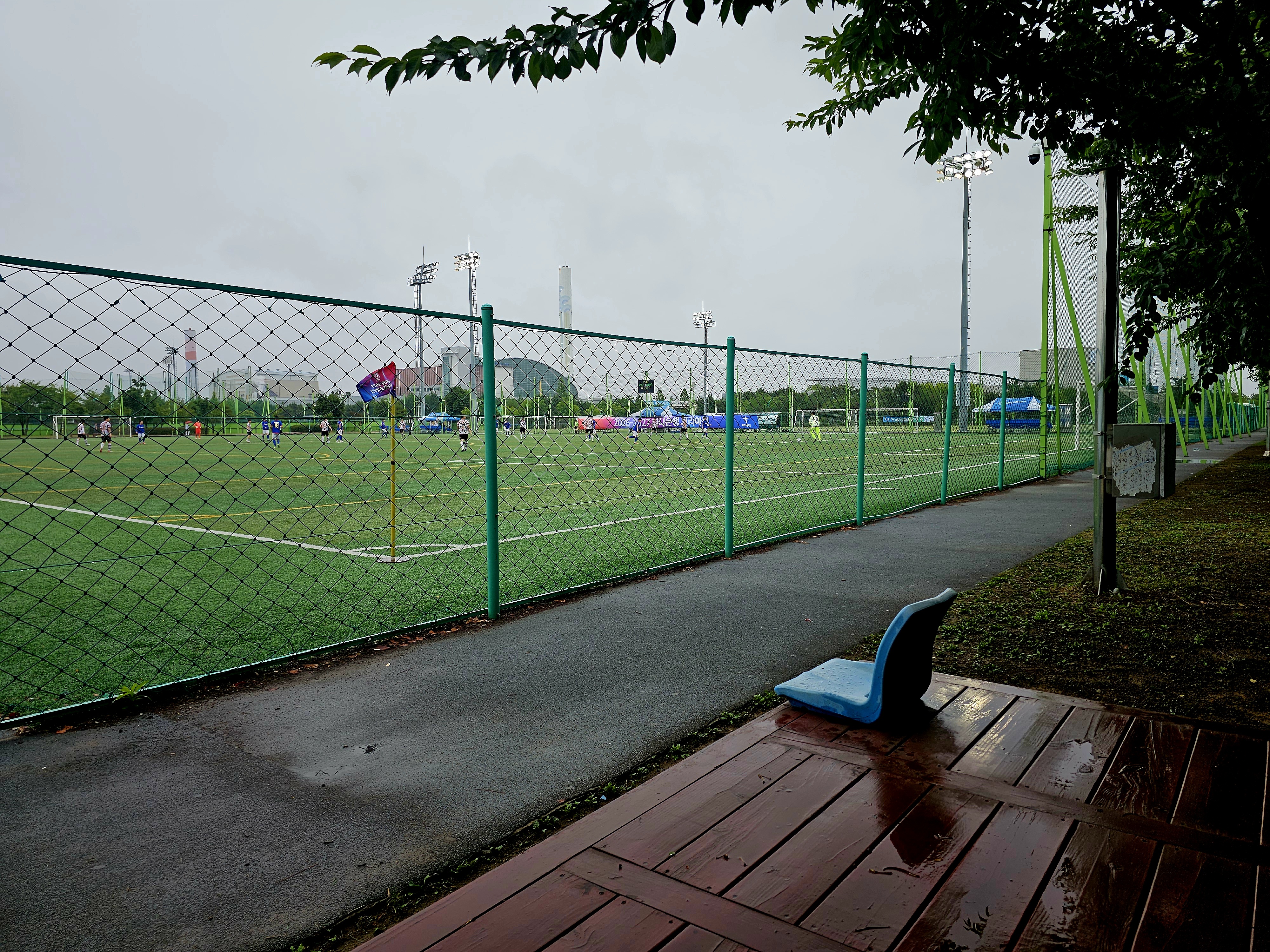
The 2026-27 Hana Bank Korea Cup is up-and-running after K5 teams slogged it out in remote destinations. None were more mysterious than Songdo LNG Sports Town.
There is an industrial terminal covering about 1.48 million square meters on reclaimed land in the West Sea off the coast of Incheon.
The name of the island is KOGAS Incheon LNG Production Base, but most people refer to it as Songdo LNG Island. LNG stands for Liquefied Natural Gas.
The basic reason for this island is energy. The terminal receives massive LNG tanker ships, stores the gas in giant insulated tanks and vaporizes it to supply clean-burning natural gas and electricity to the entire Seoul Metropolitan Area.
I don’t claim to be an expert on this, so I’ll quote Maeil Business; “With 23 storage tanks alone and 1,555,660 tons of LNG storage capacity, it is the world’s largest [LNG Terminal].”
So it might surprise you that, buried deep within this island, 1.8 times larger than Yeouido in central Seoul, is a modern sports complex featuring baseball fields, football pitches, futsal courts, skating, and a huge indoor complex.
There’s even a camping zone adjacent to the ballparks.

On one of those football pitches, the 2026-27 Hana Bank Korea Cup got underway. To say this was the most obscure venue to host a match in South Korea would be a major understatement.
Instead of the colourless civic stadiums with running tracks, backed by high-rise apartments or trees that are common throughout Korea, the backdrop of LNG Sports Town is dominated by green storage tanks and red container cranes.
This was not the First Round – but rather the Pre-Round. Four matches took place on June 20, all featuring K5 teams. The winners would advance to the first round proper.
Yeonsu Songdo FC welcomed Ulsan FC to its distinctive setting. It was a journey of 376 km for an amateur team looking to begin a domestic cup adventure that could ultimately end with AFC Champions League qualification.
A more attainable target is making the second round, when the K League 2 teams join, and potentially meeting a former K League champion.
My journey to LNG Sports Town began with a bus that dropped me outside Incheon National University. From there, a short walk to a promenade overlooking the island. To my right was Incheon Airport, invisible through the morning rain.
Reaching the island is not easy. There’s a small bridge near the university that has no footpath or bike path. With tankers and lorries crossing every few seconds, this is not a route that appeals.
The island is served by a local bus, but the service is infrequent. With my dreams of reaching the stadium by foot in ruins, there was no option but to call a taxi.

It was impossible not to marvel at the sheer size of the facility which is also home to Incheon Sin-Port. To the left were containers belonging to Maersk Sealand, Hanjin, China Shipping, and countless others. Block after block. Crane after crane. Tanker after tanker.
Was this really the right location for Korea Cup football?
My taxi dropped me next to the camping site. The floodlights were visible through the drizzle. It was wet, it was dark, but it was perfect for the setting.
Now and again, a fog horn would pierce through the murky clouds. Then a heavy vehicle would rumble into the nearby port. There was no mistaking where this match was taking place.
The main stadium has two small bleachers and an uncovered stand at halfway for the television cameras. The match was broadcast live on YouTube. Also occupying the stand were two medical personnel and the KFA’s official match commissioner.
Outside, banners highlighted the significance of the occasion. They stood beside a replica of the FIFA World Cup trophy, a fitting sight with the tournament underway in North America.
Ulsan won 4-0. That’s all I remember from the 90 minutes. As ever when you drop down the divisions, the intrigue is elsehwere. For example, the scoreboard stopped operating with 15 minutes to play, with the score at 2-0.

The highlight, however, was standing next to the small home crowd. They were friends and family of the players. They had a banner and one chant – Songdo F-C~~~!!!
Supporters would regularly vacate their position in the bleachers to chat to players in the dugout. A few even helped themselves to the bottles of energy drink laying damp in the summer rain.
Substituted players would be consoled by fans who’d hug them pitch side. It got too much for the old match commissioner. Mid-way through the second half, he climbed out of the uncovered stand to bark at supporters in the technical area.
It was a reminder, at last, that this is a national domestic cup competition—a tournament that will, over the course of the year, welcome Siheung Citizen (K3), Suwon Samsung (K League 2), and defending champions Jeonbuk Hyundai.
But it began here. Next to storage tanks, cranes, and shipping containers. A very long way from the pomp and pageantry of the final at a World Cup Stadium in Seoul.
This truly is the magic of the cup.
Leave a Reply