

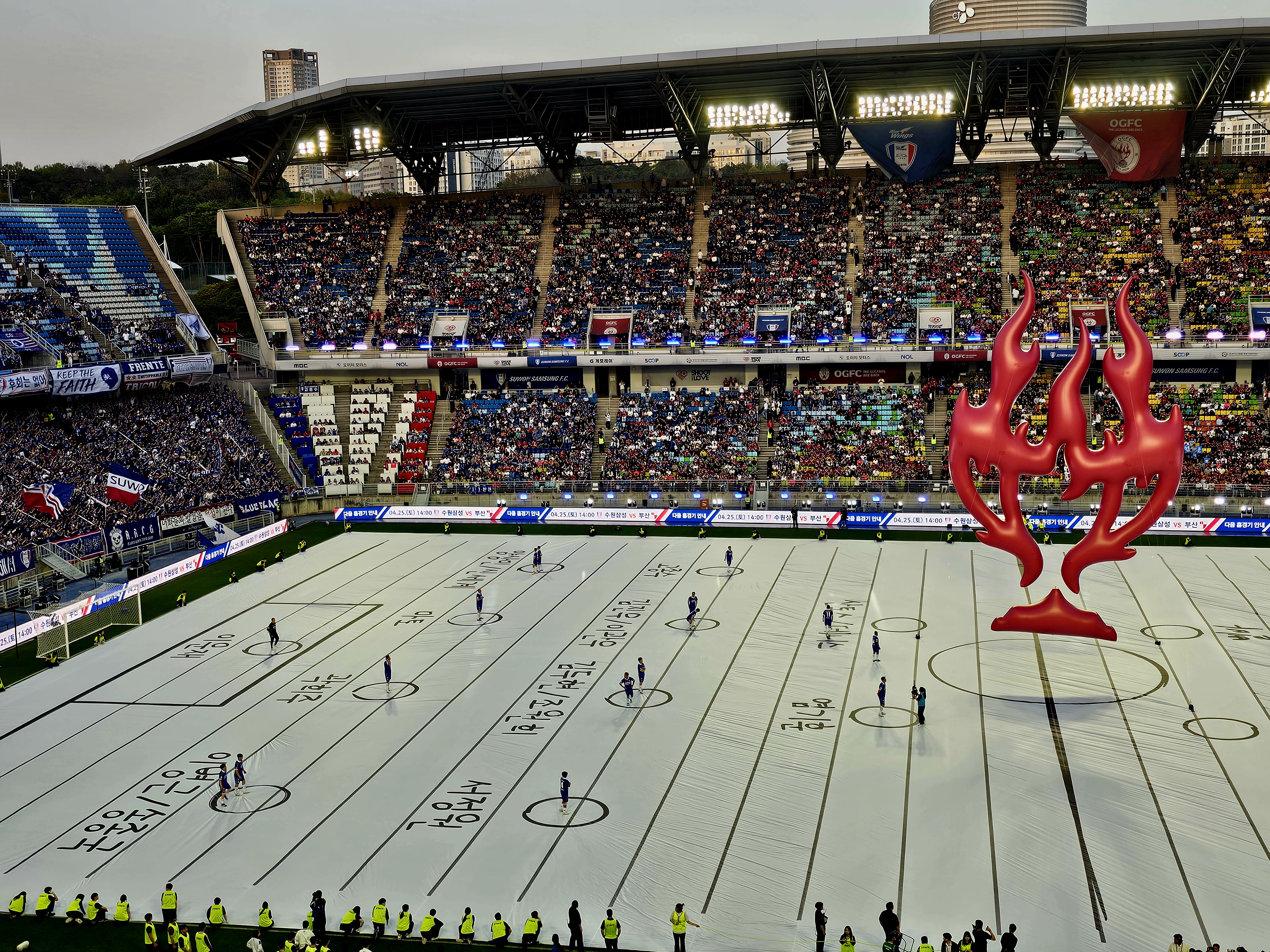
Seoul World Cup Stadium hosted a legends match featuring former FC Barcelona and Liverpool players in June. Why are these matches coming to Korea, and are they worth attending?
This is a simple — and effective — way to sum up football in this country.
To Koreans, football is immensely popular. It would be very difficult to meet an elementary school boy who does not understand the basic rules of the sport, let alone a grown adult.
However, football in Korea is not as popular domestically as baseball. And it isn’t even close. The Korea Baseball Organization (KBO) announced five million spectators had attended games well before the mid-point of the season.
That is an average of 18,334 per game. Extraordinary figures since they play six nights a week, so there are as many Tuesday games as Saturday games. Also, 61% of the first 275 games were sold out.
Compare that to K League, which is mostly played on weekends. The average attendance is just 9,330. As evidenced by the images from central Seoul after the recent World Cup win over Czechia, football is incredibly popular. But the K League is a distant second to KBO.

On any given weekend, there will be a Korean baseball fixture on terrestrial TV, while K League matches are often found on obscure channels, such as number 982 on my TV package.
It is against this backdrop that an increasing number of high-profile friendlies and legends matches are taking place.
What are these matches?
There are two main kinds of summer football events in Korea:
1. Clubs on tour
Every summer, major European clubs generate huge revenue by staging pre-season friendlies in the USA, Southeast Asia, South Korea, Australia, and other territories.
Given the huge distances between Europe and most of these destinations, seeing these clubs might be a once-in-a-lifetime opportunity for supporters.
In recent seasons, Tottenham Hotspur, Newcastle United, Barcelona, and Atletico Madrid have toured Korea. This summer, Bayern Munich are scheduled to arrive.

Their opponents are usually K League clubs, a K League Dream Team, or other touring sides.
2. Legends matches
In 2026, a new type of fixture was added to the roster of highly-lucrative mid-season matches. Suwon Samsung Bluewings Legends hosted a squad of former Manchester United players called OGFC in Suwon.
Then, on June 6 at Seoul World Cup Stadium, FC Barcelona played Liverpool FC in a one-off event called 2026 Champions Impact in Seoul.
In previous seasons, the capital has also hosted the Nexon Series, featuring retired former professional players.
What is the problem?
For starters, these matches have little or no competitive value. They are either pre-season warm-ups featuring endless substitutions or well-publicized exhibitions involving retired ex-pros.
Secondly, organisers understand there is an enormous market for football in Korea that is not fully being served by the domestic product. Many football fans will pay significant fees for one-off events — perhaps driven by FOMO — because they are less engaged with local football.
Korea will probably continue to attract these matches for the same reasons: huge interest in the sport, a wealthy consumer base, and fans with disposable income willing to spend on marquee events.
When major European clubs announce their summer tour plans, the destinations are usually familiar: the USA, Canada, Southeast Asia, East Asia, and Australia. All for the same reasons as above.
Perhaps because of the World Cup, this will be a quieter summer for friendlies in Korea. Bayern Munich face Jeju SK in Seogwipo before flying to Hong Kong to play Aston Villa, while Borussia Dortmund will visit Japan.
How much do these matches cost?
The cheapest seat to see Barcelona vs. Liverpool was ₩40,000 — more than double the price of many K League 1 tickets. K League 2 matches are as cheap as ₩10,000 in some cities.
Is it all bad news?
Not entirely.
There is nothing wrong with paying in to see these events. Fans are free to do whatever they want with their income. Just because a Korean football fan loves the sport, doesn’t mean they are required to invest in the local league, either.
Having attended some of these matches over the years, it is clear that supporters genuinely enjoy themselves. Whether seeing legendary players such as Luis Figo, Rivaldo, and Andres Iniesta, or current professionals at their peak, Korean fans fill the stands with “woooo” and “wooooow”.
Suwon Samsung vs. OGFC attracted more than 38,000 supporters, around 13,000 more than the Bluewings’ biggest home crowd of the season. Football purists may dislike that statistic, but it proves these matches are here to stay.

The players also seem to enjoy their time in Korea, even if the visits are brief. Darron Gibson, who represented OGFC, told me in the mixed zone about the team’s trip to Hwaseong Fortress, where they tried their hand at archery.
Fans can meet players at official events, and clubs heavily involve their stars in marketing campaigns, producing hours of content for TikTok and Instagram.
My conclusion
Do yourself a favour: buy a ticket for a local K League match instead. It will probably be more fun, less exploitative, and significantly cheaper.
Leave a Reply